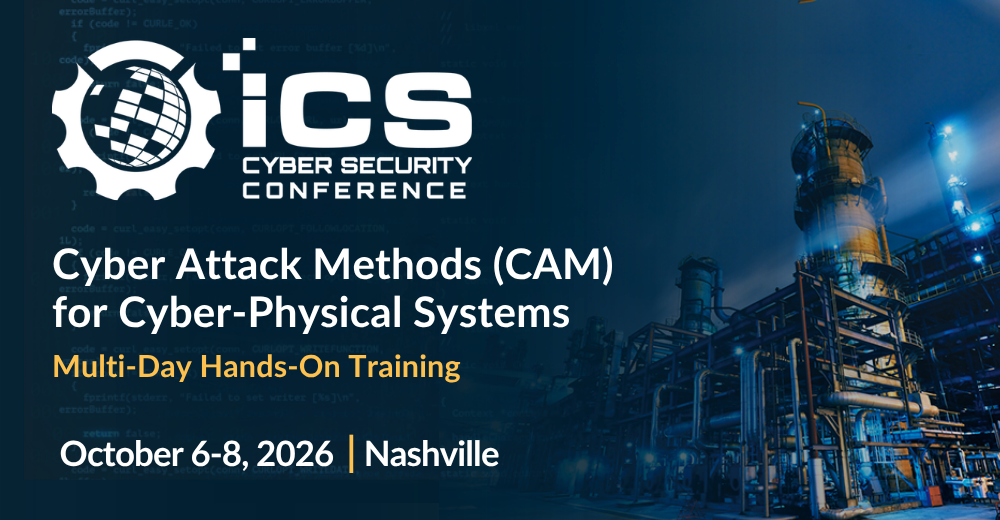
This October, SecurityWeek, in partnership with MTSI, will offer the Cyber Attack Methods (CAM) course for the second consecutive year as part of the 25th Anniversary Industrial Control Systems (ICS) Cybersecurity Conference.
Understanding Cyber-Physical System Attacks
Understanding how adversaries compromise cyber-physical systems requires more than reading threat reports or reviewing lists of attack techniques. Defenders must understand how attackers examine a system, identify opportunities and connect individual weaknesses to achieve a larger operational objective.
Cyber-physical systems connect digital components with equipment and processes in the physical world. A successful attack against these environments can extend far beyond the loss of data or temporary system downtime, potentially affecting safety, mission readiness, productivity, revenue and the availability of essential services.
The Cyber Attack Methods Course
The multi-day, hands-on course will take place October 6–8 at the W Nashville alongside the special 25th anniversary edition of the ICS Cybersecurity Conference. The course is designed to help participants understand how those attacks unfold by placing them directly in the role of an adversary.
Working inside an intentionally vulnerable virtual cyber-physical environment, students will progress through system discovery, vulnerability exploitation and the execution of mission-focused attacks. Rather than discussing adversary behavior only in theory, participants will work through the attack process with their hands on the keyboard.
The objective is not to turn students into hackers. It is to give the people responsible for designing, building, testing and protecting cyber-physical systems a practical understanding of how attackers think and operate.
Who Should Attend
While security practitioners can benefit from the course, CAM is particularly relevant for the broader community responsible for cyber-physical systems—including systems engineers, security engineers, programmers, developers, designers and testers.
No previous cybersecurity experience is required. The guided course is intended to make the material accessible to participants from different technical backgrounds, although familiarity with the Linux command line and some programming experience will help students get the most from the exercises.
MTSI's Cyber-Physical Systems Team
MTSI’s cyber-physical systems team brings experience in hacking, reverse engineering and penetration testing across mission-critical aviation, maritime, weapons and defense systems. Team members also conduct cyber-physical security research and have competed successfully in prominent hacking competitions, including DEF CON’s ICS Village and Biohacking Village capture-the-flag events.
The course is available exclusively to United States citizens. Seats for this immersive training are limited. Engineers, developers, testers and security professionals who want to move beyond abstract descriptions of cyber-physical attacks and experience the attack process for themselves are encouraged to register as soon as possible.
The $3,995 registration fee includes: The complete Cyber Attack Methods training course, a self-contained virtual machine containing the CAM simulation, exercises and lesson content, a certificate of course completion, access to ICS Cybersecurity Conference sessions, conference meals, networking events and social functions — full conference pass.
Participants must bring an Intel-based laptop capable of running the required virtual machine. ARM-based MacBooks are not supported. Students may retain the course virtual machine after the event, allowing them to revisit the exercises and continue learning beyond the classroom.
The 2026 ICS Cybersecurity Conference takes place October 6-8 at the W Nashville, bringing together operations and control engineers, IT and OT security professionals, government representatives, researchers, vendors and critical infrastructure operators for SecurityWeek’s 25th anniversary industrial cybersecurity event.
Written By Mike Lennon, who has been closely monitoring the threat landscape and analyzing trends in the National Security and enterprise cybersecurity space for over 15 years.
Source: SecurityWeek