Introduction to AI Agents
AI agents are designed to reason probabilistically, choosing the next best action, observing the result, and adapting. This loop is what makes them powerful, but it is also why security models built around predictable workflows break down.
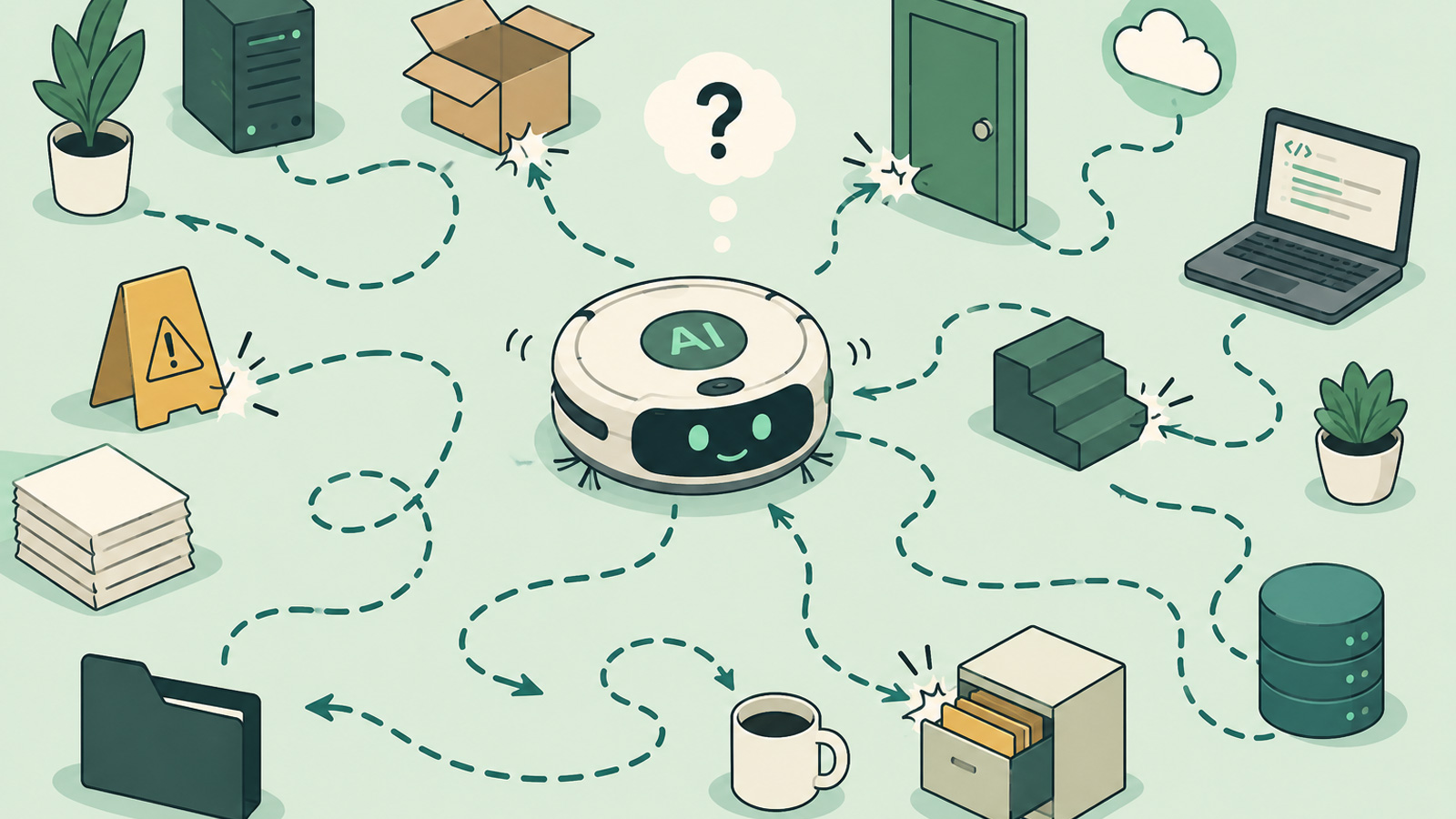
Watch an agent work through a task, and you’ll see the future of enterprise security. It can spend 4 minutes trying to read a CSV that turned out to be a folder, give up, write a script to list its contents, and then get there. It works. Just never the way you sketched it in your head.
The Problem of Securing AI Agents
The question is: How do you secure a system whose next move you cannot predict? Every team deploying agents runs into the same access decisions, usually without noticing: Do you give an agent every tool that might help, or only the ones it will probably need?
Do you grant admin authority because some edge case could call for it? Do you provision agents with broad access, or scope it down to the specific request in front of the agent right now? Are all of these connectors needed? Which need admin access? Are they needed for every session?
The Usual Playbook Fails
For two years, most AI security efforts went into shaping how models respond. Guardrails that include prompt filtering, input and output constraints, and behavior controls. While these are useful in many contexts, they are the wrong layer for the problem in front of us.
Prompt filters try to constrain behavior. With natural language as the interface and an infinite number of possible prompts, there is always another way in. Filtering that works ninety-nine percent of the time still fails, because one percent of infinity is still infinity.
Why Identity is the Only Control Plane That Holds
Strip away the model, the prompt, and the framework, and one thing stays constant: every action an agent takes runs through an identity. It authenticates with a service account, an API key, an OAuth grant, a cloud role, or a token.
All actions, from reading data to modifying infrastructure, depend on the permissions of an agent’s identities. That is why identity, not prompt filtering, is the control plane for agentic AI.
Intent Is the Missing Dimension
Traditional access control asks what an identity can do. For agents, that is not enough, because purpose is what separates safe behavior from dangerous behavior. An agent resolving a failed deployment and an agent exfiltrating data may perform nearly identical low-level actions: reading logs, calling APIs, and accessing a database.
From an IAM perspective, they look the same, but their intent is not the same at all. Intent-based security adds that missing context. Instead of asking 'what can this agent access,' you ask 'what should this agent be able to access to accomplish its purpose, and nothing more.'
Visibility Is Table Stakes. Enforcement Is the Point.
Most tools stop at visibility. An inventory of agents is necessary, but it does not change what an agent is allowed to do. Knowing you have a problem is not the same as fixing it, and users will keep granting as much access as they can to get their work done faster.
The work that actually reduces risk is preventative and continuous: Discover every agent and the identities it uses, across cloud, SaaS, endpoints, and AI platforms, including the shadow agents nobody registered.
Understand what each agent can access and what it is meant to do, so you can right-size permissions to intent. Enforce that scope automatically, revoke access when an agent is retired, and govern the full lifecycle from creation to decommissioning, because risk does not appear at creation.
It accumulates as access piles up and ownership blurs. Agents guess. That is their nature, and it is not going to change. What you can change is the blast radius of a wrong guess.
You do that at the identity layer, scoped to intent, and enforce it before the action rather than explain it after. Your agents will keep improvising. The question is whether they are improvising inside boundaries you set, or boundaries you never drew.
To learn how to secure AI agents at scale, consider a demo of a security solution that can help you manage the risks associated with AI agents.
Source: BleepingComputer