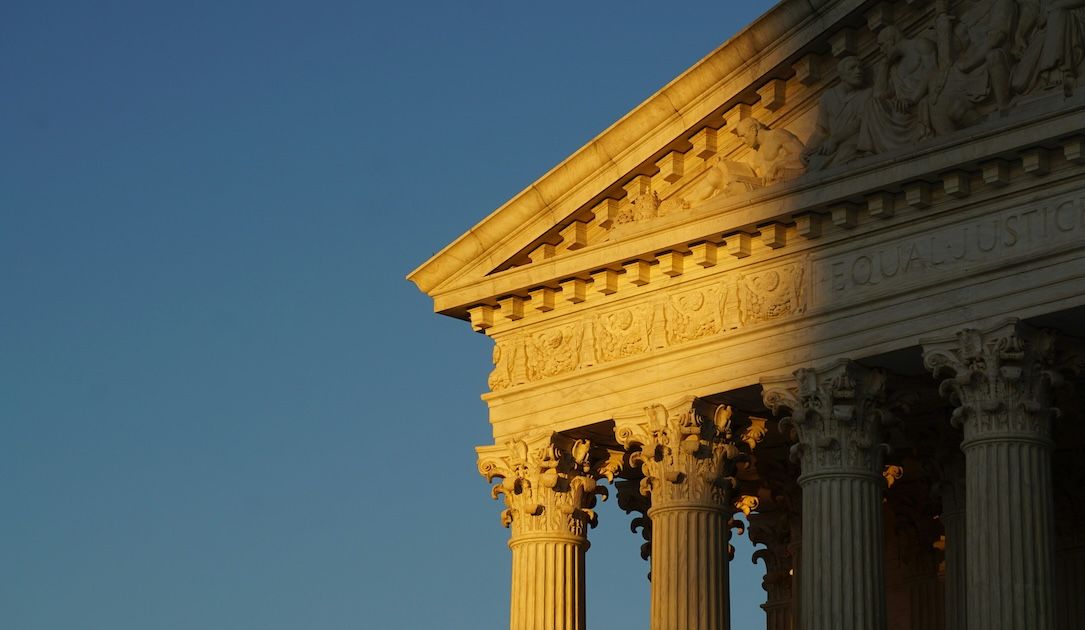
Justices Signal Broad Support for Warrant Requirement
During oral arguments held Monday, the U.S. Supreme Court strongly indicated it is prepared to rule that law enforcement sweeps of all cell phones present near a crime scene — commonly known as geofence searches — constitute Fourth Amendment protected searches and therefore require a warrant before they can be carried out.
Although police in practice typically obtain warrants before executing geofence searches, the federal government has taken the position in Chatrie v. United States that such investigative techniques do not trigger Fourth Amendment protections at all. That argument appeared to find little traction with the majority of the justices assembled Monday.
What Is a Geofence Search?
A geofence search — sometimes called a reverse location search — involves law enforcement asking a technology company such as Google to provide identifying information about every device whose location data places it within a defined geographic boundary during a specified time window. These searches are conducted without targeting any particular suspect, casting a wide net over anyone who happened to be in the area.
Privacy advocates had entered the hearing deeply concerned that the court might side with the government, potentially opening the door to warrantless use of a far wider range of reverse searches — including those in which police ask Google to identify everyone who searched for a particular keyword online.
Cross-Ideological Concerns From the Bench
The justices did not divide along their typical ideological lines during arguments. Justice Neil Gorsuch, a conservative, joined liberal Justice Sonia Sotomayor in pressing the government's attorney on whether his legal theory would also permit police to seize other personal data — such as photographs, emails, and Google documents — without a warrant. The pointed questioning from both ends of the ideological spectrum reinforced the impression that a majority will ultimately require a warrant for such searches.
Some justices, however, appeared skeptical of the argument advanced by Chatrie's lawyer, Adam Unikowsky, who contended that geofence searches should be treated as general warrants — the kind of blanket, cause-free search authority exercised by British officers during the colonial era, which are explicitly prohibited under the Fourth Amendment. While that specific framing drew pushback, concerns about the breadth of geofence searches were widely shared across the bench.
The Chatrie Case: Background
Okello Chatrie, the plaintiff in the current case, is serving a nearly 12-year sentence for bank robbery. His conviction rested substantially on evidence obtained after police asked Google to turn over the names of everyone whose cell phone location data placed them in the vicinity of the robbed credit union during the time frame of the crime. The geofence search identified Chatrie, ultimately leading to his prosecution.
Google Weighs In on Scope and Invasiveness
Google filed an amicus brief in support of Chatrie, arguing that geofence warrants are frequently broad and deeply invasive. The company provided concrete examples to illustrate the scope these searches can reach:
- One geofence warrant covered several search areas totaling a combined 2.5 square miles of San Francisco over more than 48 hours. "This geofence warrant would have exposed the location history of thousands of users," the Google brief stated.
- In a separate case, police sought data that would have encompassed more than 3,000 users located within a 489-acre area that included the Islamic Center of New Mexico, 50 homes, 30 apartment buildings, a park, major roadways, and a portion of the University of New Mexico campus.
A Landmark Moment for Digital Privacy Law
This marks the first Supreme Court case addressing digital data privacy since the court's 2018 ruling in Carpenter v. United States, the landmark decision that established police must obtain a warrant to access seven days or more of an individual's historic cell-site location information gathered from cell towers.
Andrew Guthrie Ferguson, a law professor at George Washington University and author of Your Data Will Be Used Against You, characterized the court's apparent direction as reflecting its broader pattern in digital surveillance cases.
"As we have seen in the Supreme Court's other digital surveillance cases, the Justices seem to be more comfortable with a compromise approach, requiring judicial warrants to put some limits on law enforcement searches, but also not banning them completely," Ferguson said.
Ferguson also noted that while some justices focused on how "particularized a warrant must be," the court's apparent willingness to require warrants at all represents a meaningful development, given that there is currently no legal mandate for them. Police have historically sought warrants for geofence searches largely as a precautionary measure — a "concession that they think a court might require one," in Ferguson's words.
Why the Stakes Are High
Ferguson underscored the significance of the outcome for civil liberties and law enforcement practices nationwide.
"That is why this case is a big deal," Ferguson said. "If the government's argument wins, police can get a geofence warrant without any probable cause, for any reason, against anyone, anywhere in America."
The court's eventual ruling is expected to set binding national standards for how — and under what legal threshold — law enforcement may use location data to identify suspects in criminal investigations, potentially reshaping digital privacy protections for millions of Americans in the process.
Source: The Record