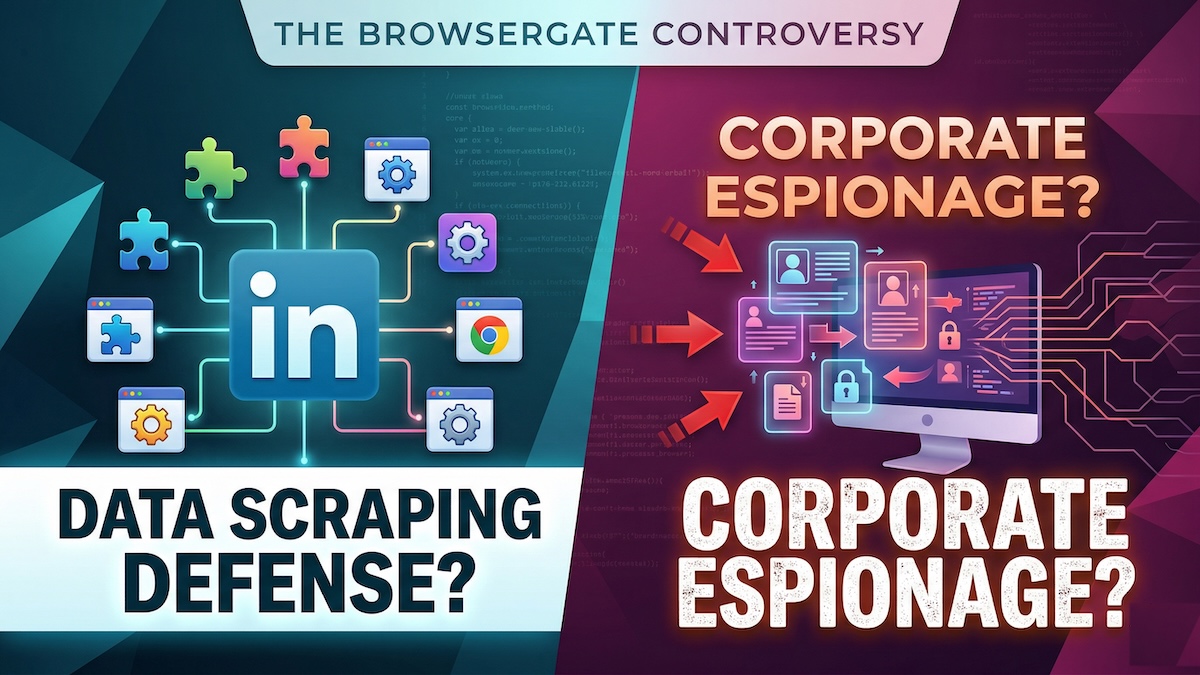
What Is BrowserGate?
A wave of alarming claims has swept the internet accusing Microsoft-owned LinkedIn of secretly scanning users' computers to fingerprint and build detailed profiles on its members. The controversy has been branded BrowserGate, and anyone searching that term on Chrome, Edge, or Safari will likely encounter a boldly worded page declaring: "LinkedIn Is Illegally Searching Your Computer." That same page carries the subtitle: "Microsoft is running one of the largest corporate espionage operations in modern history."
The BrowserGate website, hosted at the browsergate.eu URL, is operated by a group calling itself Fairlinked — described as an association of commercial LinkedIn users. The group has published what it terms an exposé, and its accusations are sweeping in scope.
The Core Allegation
At the heart of BrowserGate's claims is a specific technical process. According to the group, whenever a user opens LinkedIn on a Chrome-based browser, embedded JavaScript silently scans for approximately 6,000 browser extensions, collects the results, encrypts them, and transmits the data back to LinkedIn's servers.
The group argues that many of the extensions being probed can reveal deeply sensitive information about a user, including their political opinions, religious beliefs, disability status, neurodivergence, sexuality, employment situation, and even company trade secrets. In the BrowserGate narrative, this makes the activity one of the most significant privacy violations in recent corporate history.
BrowserGate also claims a regulatory dimension. In 2023, the EU designated LinkedIn as a regulated gatekeeper under the Digital Markets Act and instructed the platform to open itself up to third-party tools. The group alleges that LinkedIn's actual response was to dramatically expand its surveillance of those very tools — growing from roughly 461 products in 2024 to over 6,000 by February 2026.
LinkedIn's Official Defense
LinkedIn has pushed back firmly against the characterization. In a post on Hacker News, the LinkedInHelp account explained the company's position:
"We use this data to determine which extensions violate our terms, to inform and improve our technical defenses, and to understand why a member account might be fetching an inordinate amount of other members' data, which at scale, impacts site stability. We do not use this data to infer sensitive information about members."
In other words, LinkedIn frames its behavior as a defensive measure aimed at protecting platform integrity rather than profiling individuals.
What the Security Research Actually Shows
Tyler Reguly, associate director of security R&D at Fortra, conducted an independent technical investigation and shared his findings with SecurityWeek. His conclusion differs substantially from the BrowserGate framing.
Reguly characterizes the LinkedIn activity as resource probing — a well-known JavaScript technique used to determine whether a specific browser extension is present. He was unequivocal on one point: "Yes, LinkedIn was probing for a lot of extensions, but there was no scanning of your computer and no malicious code, just a simple JavaScript technique to determine if the extension was there."
Testing the Extensions Themselves
To better understand what was actually being detected, Reguly tested a sample of roughly 10 percent of the 6,000-plus extensions on the probe list. What he found was striking — but not for the reasons BrowserGate would suggest.
- One extension refused to close its tab and kept reopening itself.
- Others altered his home screen, modified the
about:blankpage, and added unauthorized bookmarks. - At least one extension Rickrolled him, automatically playing the music video for Never Gonna Give You Up every time he opened his browser.
"To say that a lot of these are the worst of the worst extensions out there is not an understatement," Reguly noted. He also pointed out that even the figure of 6,000 extensions is a small subset of all extensions in existence, and he estimates that LinkedIn's method could realistically only detect around 2,000 of them even under ideal conditions.
No Malicious Intent Detected
On the question of intent, Reguly was direct: "I don't see anything that indicates malicious intent here. It is discovering some information, yes, but I don't think it crosses the threshold to malicious — I think that's a very sensationalized view of what's going on."
He theorized that a common thread among the flagged extensions is their data-scraping functionality. Many were obscure and behaved suspiciously during testing. "Many of them gave me that used-car-salesman vibe that you see in the movies," he said. "I can't help but wonder if LinkedIn wanted to know if these extensions were there to try and defend against them."
Reguly went further, suggesting a reframing of the privacy calculus: "I feel that a user with these extensions installed visiting my LinkedIn page is more of an affront to my privacy than LinkedIn checking to see if I have these extensions."
Legal Gray Areas Remain
Even if LinkedIn's motives are defensive, the legal picture is complicated. Ilia Kolochenko, a lawyer specializing in cybersecurity, data protection, and privacy law, told SecurityWeek that the legality of such fingerprinting hinges on specific facts and jurisdiction.
"If used without notice and for commercial gain, in some countries, it may even constitute a criminal offense. In any case, if you don't have a freely given and informed user consent to collect such data — that highly likely amounts to personal data under GDPR and most other privacy laws and regulations — the data collection may be a grave infringement of applicable privacy law," Kolochenko said.
This means LinkedIn's behavior, whatever its intent, may still carry legal risk in certain markets simply because users are not clearly informed about it. The platform has not made the process transparent, and signing users up without explicit disclosure of this data collection practice could expose it to regulatory scrutiny.
What LinkedIn Should Do Differently
Reguly acknowledged that LinkedIn is not entirely without fault. His principal criticism is one of transparency: "I think the only downside I see is that LinkedIn wasn't notifying you that you had these potentially problematic extensions installed."
He also offered a constructive take for security professionals, suggesting that rather than treating the revelations as a scandal, administrators and security teams should treat the published list of extension IDs as a useful resource — one that identifies potentially dangerous tools worth blocking at the organizational level.
The Verdict: Sensationalism vs. Legitimate Concern
Ultimately, BrowserGate sits at the intersection of a real technical behavior and a highly charged interpretation of it. LinkedIn is indeed using JavaScript to probe for thousands of browser extensions, and it has not been forthcoming about this practice with its users. Those are legitimate concerns, particularly in jurisdictions with robust data privacy frameworks like the EU's GDPR.
But the leap from that behavior to "one of the largest corporate espionage operations in modern history" is, by Reguly's assessment, a significant overreach. His conclusion was blunt: "I can't help but look at this as a giant nothingburger."
The more nuanced takeaway is that LinkedIn should be transparent about what data it collects and why — and that users and regulators alike are right to demand clear answers. Whether that demand is best served by apocalyptic rhetoric or careful technical scrutiny is another matter entirely.
Source: SecurityWeek